

On 1 July 2026, something quietly changed on every Australian mobile phone. Since then, text messages sent with an unregistered brand name at the top have arrived labelled "Unverified", bundled into the same thread as the scams.
If your SMS still says your company name, congratulations, somebody in your business did the paperwork. But it is worth sitting with what the SMS Sender ID Register actually represents, because it is not really a compliance story. It is a signal about where customer engagement is heading. Identity is becoming part of the message. Not a bolt-on, not a login step. Part of the message itself.
Which raises an awkward question for most contact centres. If identity is now part of the message, why is it still sitting in a different system to the messages?
Four channels, four systems, four memories
Here is the stack most Australian mid-market businesses are running, whether or not anyone has ever drawn it on a whiteboard.
- A bulk SMS tool, usually bought by marketing, usually no-reply.
- A contact centre platform handling inbound voice.
- A marketing automation platform sending the email.
- An identity or 2FA tool wired into the website by IT, some years ago.
Four vendors. Four contracts. Four sets of reporting. And, crucially, four separate memories of the same customer, none of which are on speaking terms.
This is not incompetence. It is history. Each tool was bought to solve a real problem at a real moment, and each one solved it. The trouble is that customers do not move through your org chart. They move through their own day, and they expect the company to keep up.
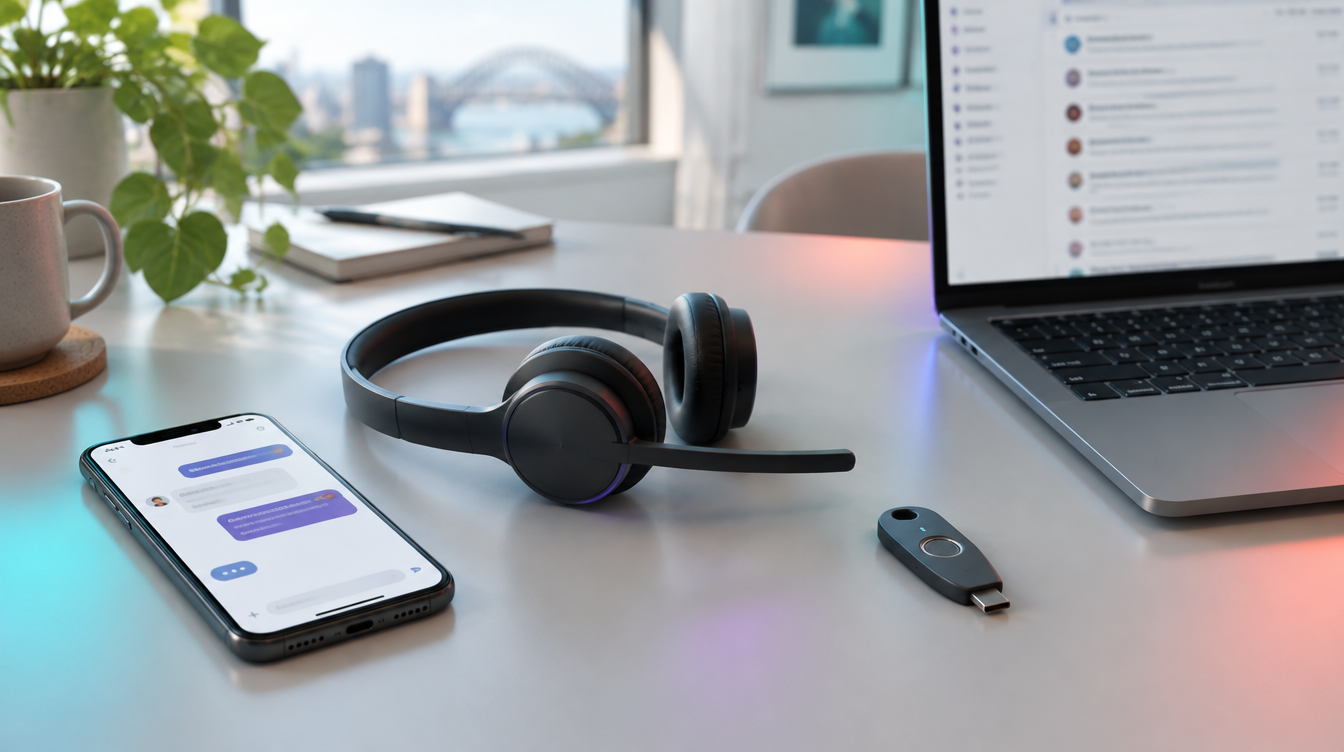
What each service is actually for
Strip away the acronyms and there are only four jobs.
Messaging is where the conversation usually starts. It is fast, it is read, and in Australia it is now identity-verified at the carrier level. The mistake most businesses make is treating it as a broadcast channel: a no-reply number is a door with no handle. Twilio Messaging handles SMS, MMS, RCS and WhatsApp through one API, with sender registration and deliverability already taken care of. Two-way, branded, verified. That is a conversation, not a notification.
Voice is where the hard conversations go, simply because human beings escalate to speech when something matters. Gartner found that only 9% of customers resolve their issue completely through self-service. The phone is not a legacy channel. It is the safety net, and it needs to open already knowing the history. Twilio Voice gives you programmable inbound and outbound calling, transcription and analysis, so a call is not a black box that ends when someone hangs up.
Email is where the record lives. It is the channel customers scroll back through when they want to check what was agreed. That makes it the worst possible place to send something generic. "Dear valued customer" is four words that admit you have no idea who you are talking to. Twilio SendGrid delivers email at a scale most businesses will never test, but the point is not volume. The point is that the email can reference the actual conversation.
Identity is what makes the other three safe. This is the one businesses treat as a cost and it is the one that unlocks everything else. Gartner found that 10% of consumers and 24% of business customers who received proactive outreach contacted the company purely to check the message was not a scam. Think about that. A quarter of your business audience is ringing you to ask whether your own message is real. Twilio Verify confirms identity across SMS, voice, email, WhatsApp and silent network signals through one API, which means you can be confident who you are talking to, and they can be confident it is you.
A quarter of your business audience is ringing you to ask whether your own message is real.
The memory is the product
Here is the part most businesses have not caught up with yet. On Twilio, these are not four separate services any more. They run on one platform, and Twilio's conversation layer is what holds the thread between them. Conversation Orchestrator joins every message, call and email into one continuous conversation. Conversation Memory keeps an identity-resolved record of what the customer has said and done. Segment brings in the customer data you already hold.
That thread is the whole game. It is the difference between a customer who is recognised and a customer who is processed. And the evidence that it pays is not subtle: Twilio research found consumers spend an average of 54% more with brands that personalise their experience, while only 16% of businesses strongly agree they have the customer data they actually need to do it.
Sixteen per cent. The intent is not the problem. Getting the data into the conversation is.
This is where NeonNow works side by side with Twilio. NeonNow IQ takes that shared memory and puts it to work inside the contact centre: intent, sentiment, resolution state and a summary an agent can act on in three seconds, whether the next interaction is a human, an automated agent, or an email that goes out at 6pm.
One platform, ready for your contact centre
We built NeonNow Outreach for Australian mid-market businesses that want everything Twilio's platform can do, running in their contact centre, without standing up an engineering team to get there.
Outreach brings Twilio's messaging, voice, email and identity to you as one product, with Twilio as the platform underneath. One contract instead of four. One set of reporting instead of four. Sender ID registration, deliverability, verification and compliance handled as part of the service rather than as four separate projects with four separate owners. And one memory, held by Twilio and put to work by NeonNow IQ, that persists as the customer moves from a text to a call to an email and back again.
It plugs into NeonNow CX for organisations that want the full contact centre, or stands on its own for organisations that mostly need to reach people well.
What you get out the other side is not four channels working harder. It is one conversation that happens to use four channels, which is the thing your customers assumed you had all along.
What changes once the four work as one
Consolidation is one of those words that sounds like a slide and feels like a migration project, so let me be specific about what it buys you day to day.
The agent stops asking. This is the visible one, and it is the one your customers will notice within a week. A call that follows a message opens with the context of the message attached to it.
Outbound stops being a dead end. A no-reply SMS generates inbound calls, because customers who have a question have nowhere else to put it. Make the message two-way and the question gets answered where it was asked, at a fraction of the cost of a call.
Compliance stops being four projects. Sender ID registration, opt-out handling, deliverability, verification and record keeping stop living in four places with four owners and four renewal dates. In a market where the rules changed on 1 July 2026, that is not a small thing.
And reporting starts telling the truth. Right now, your channel reports each show a system doing its job. A single view shows you the journey, which is the only unit of measurement the customer actually experiences.
Three questions worth asking any vendor
If you are in market for any of this, the demo will look great. They always do. These are the questions that separate the platforms that hold the thread from the ones that just claim to.
- When a customer moves from a text message to a phone call, what exactly does the agent see, and who built that integration?
- If we verify a customer in one channel, is that verification trusted in the others, or does she do it again?
- Where does the summary of what was said live, and can the next system read it without a project?
If the answer to all three is a diagram connecting four products from four different vendors, you are being sold four tools, not one conversation.
Start with the thread, not the tools
If you are about to go shopping for a messaging platform, do yourself a favour and change the question. Do not ask which tool sends the best SMS. Ask what happens to what the customer said in it.
Because the customer is not comparing your SMS to your competitor's SMS. She is comparing the whole experience of dealing with you to the experience of dealing with a company that remembered her.
And she has been trained by the best. Her food arrives with a map. Her flight rebooks itself before she has noticed it was cancelled. She does not know or care that those companies spent years on the plumbing. She just knows that when she came back, they knew who she was.
That is now the baseline. Not the aspiration, the baseline. Four services, four memories, is no longer a slightly clunky architecture. It is a visible statement about how much attention you are prepared to pay.
See the four services working as one
If your messaging, voice, email and identity tools are still four separate conversations, book a demo and we will show you what happens when they become one. We will walk a single customer across all four and you can watch the context travel with her.
Not ready for a screen share? Talk to our team about what bringing the four together would mean for your stack, your contracts and your compliance calendar.


.svg)


